
For more than 1.2 million years, only us humans have used fire for our own benefits. Whether having a hot meal or lighting up a dark room, the discovery of fire has changed the course of the human civilization. But today, another species is using fire for their advantage.
In Australia, three birds of the prey species: Black Kites, whistling kites, and brown falcons, use smoldering branches or twigs to spread fire in a region in order to catch their prey.
These birds gather around the edges of the fire-blazing region, where their prey, like lizards, insects, or small mammals like rabbits, run towards, to save themselves from the fire but get caught straight into their talons.
These birds gather around the edges of the fire-blazing region, where their prey, like lizards, insects, or small mammals like rabbits, run towards, to save themselves from the fire but get caught straight into their talons.
Bob Gosford, an ornithologist, said “ A group of falcons or kites would collect slowly- burning branches and drop them off at an unburnt area of grass to start a fire. ”
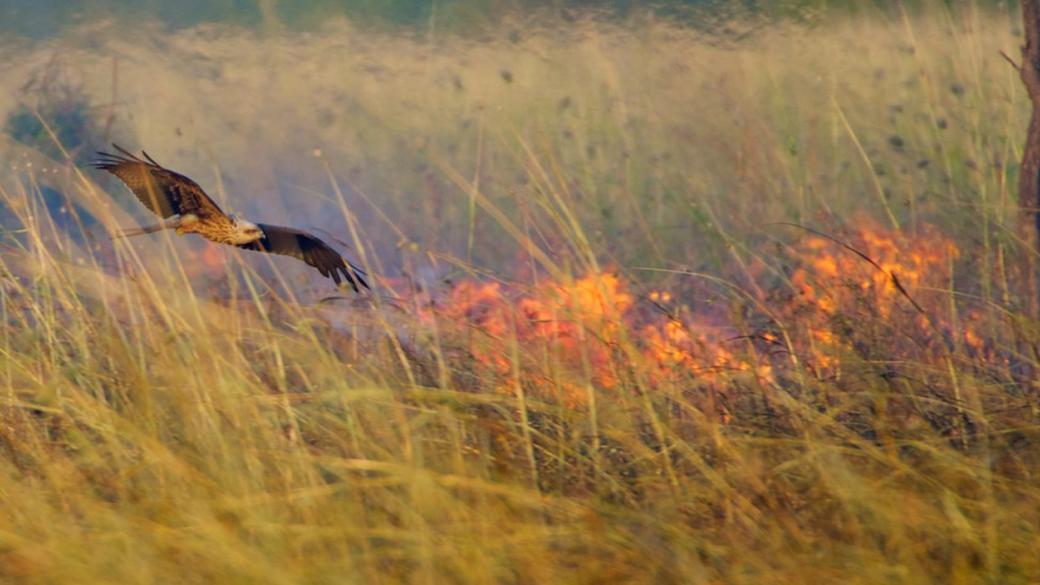
Observers reported both solo and group efforts to catch a prey in such a manner. The surprising thing is that these birds don’t just start a fire but also control its spread.
According to Alex Kacelnik, an expert on animals at the University of Oxford described the behavior of these avian species as extraordinary and suggested that birds may have better mental capabilities, in terms of understanding their surroundings. Black kites and brown falcons thrive in such situations, adapted to the frequent wildfires prone to the Australian savannah regions.
According to Alex Kacelnik, an expert on animals at the University of Oxford described the behavior of these avian species as extraordinary and suggested that birds may have better mental capabilities, in terms of understanding their surroundings. Black kites and brown falcons thrive in such situations, adapted to the frequent wildfires prone to the Australian savannah regions.
Another argument for this human-like behavior of the birds is that of confusion. Some have argued that these birds actually pick up burning twigs and branches, mistaking them for their prey and just drop it when they realize it. These cause wildfires and hence displacing many of the insects and reptiles in that area which later get caught by the Falcons and kites.
Whatever the case may be, it is for the first time in recorded history, that we see fire being controlled by a species apart from us humans.
Regards,
Sanjay Dutta
2nd Year
Dept: CSE-C
Heritage Institute of Technology, Kolkata
https://news.nationalgeographic.com/2018/01/wildfires-birds-animals-australia/?user.testname=none
Image source: https://i2.wp.com/thefreaky.net/wp-content/uploads/2018/01/arson-birds-of-prey-.jpg?w=800

:quality(75)/curiosity-data.s3.amazonaws.com/images/content/landscape/standard/3d68d85b-119d-48f6-acfe-dd7834b6d1fb.jpg)
Interesting.
ReplyDeletegood job
ReplyDeleteThanks
ReplyDeleteInteresting idea
ReplyDeleteThank you Sir.
Delete